
The rule in brief
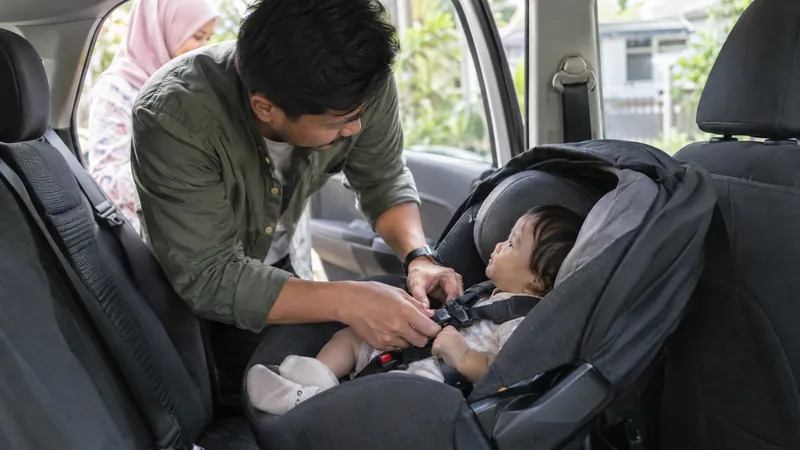
MOT states that Malaysia's child car seat rule comes from the Motor Vehicles (Safety Seat-Belts) (Amendment) Rules 2019, in force from 1 January 2020 for private vehicles. MOT describes its enforcement for this rule as an 'advocacy approach' rather than publishing a fine amount; none of the official pages we checked on 28 October 2026 state a fine, and we did not find the gazette text itself through the AGC portal's listings or search to confirm one.
MOT's page also cites MIROS data showing child-restraint awareness rising from about 44% in 2019 to about 50% in early 2020, around when the rule took effect.
Which children it covers: 'and' or 'or'?
JPJ and MOT, Malaysia's two official sources on this rule, word the same three numbers differently. We quote both exactly rather than picking one.
- BabyJourney editorial criteria: a child under 12, under 36 kg and under 136 cm at the same time is covered under every reading above.
- If your child is close to any threshold, MOT's "or" wording covers more children, so it is the cautious choice. MIROS says height comes first, with a 135 cm limit.
| Source | Exact wording published on 28 October 2026 |
|---|---|
| JPJ: CRS FAQ, Q3 | Under 12 years old AND weight less than 36 kg AND height less than 136 cm. All three conditions, joined by 'and'. |
| MOT: Child Car Seat Safety | Weigh less than 36 kg, OR height less than 136 cm, OR aged below 12 years old. Any one condition, joined by 'or'. |
| MIROS: CRS FAQ | States that height is checked first, with the limit set at 135 cm, not the 136 cm JPJ and MOT state. |
Check your numbers against both wordings
This does not decide whether your car seat rule applies to your child. It only shows which published conditions your numbers meet under each official page's wording. Nothing you type is stored or sent anywhere.
Enter age, weight and height, then press Check.
JPJ wording
MOT wording
Approved seats: R44, R129, E-Mark and the MIROS QR label
JPJ's FAQ states a child restraint system must comply with UN Regulation R44 or R129 and carry an E-Mark approval. MIROS says seats already in use do not need a QR label; the QR label is compulsory on seats sold from 1 January 2021. JPJ's FAQ states a CRS installed before 1 January 2020 may continue in use even where it does not meet the R44/R129 standard.
Front seat and airbags
JPJ's FAQ ties front-seat use of a rear-facing seat to the airbag being switched off; never fit one in front of an active airbag. JPJ's FAQ allows a CRS in the front or rear seat using ISOFIX or a 3-point seatbelt; in a vehicle without ISOFIX, the CRS is fitted using the vehicle's 3-point seatbelt.
The official exceptions
JPJ's FAQ (Q12) lists four official exceptions: any motor vehicle that is not designed for the use of appropriate CRS; when the number of passengers in the vehicle has prevented the appropriate use of CRS; health factors that have been certified by a qualified medical expert; and for public service or tourism vehicles, when the operator does not provide the appropriate CRS.
MIROS's FAQ (Q4) adds that older vehicles without a 3-point seatbelt are excluded from the CRS requirement.
Taxis, e-hailing, rental cars and flights
JPJ's exception for public service and tourism vehicles applies specifically when the operator does not provide a suitable CRS; it is not a blanket exemption for every taxi or e-hailing trip. For anything the official pages do not state directly, such as a particular e-hailing app's own policy or a rental company's car seat options, ask the operator rather than assuming a rule.
If you are flying with a car seat, or deciding whether to bring a stroller instead, see our AirAsia stroller policy guide and our guide to choosing a stroller in Malaysia, which also covers this CRS rule for travel days.
Read the approval label
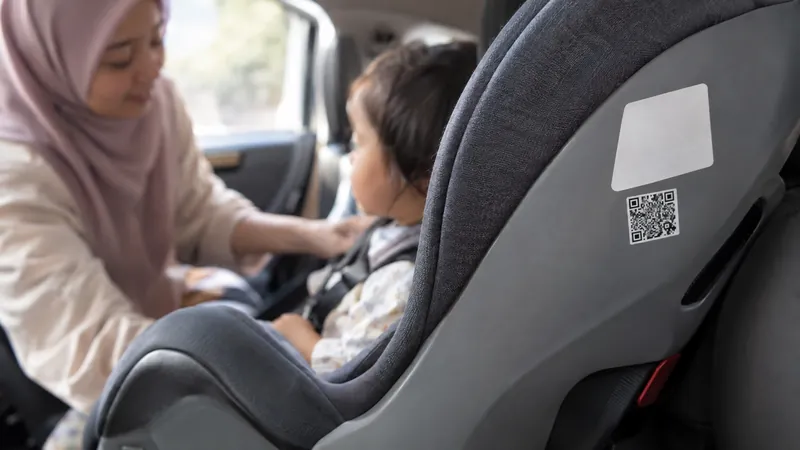
Malaysia's car seat approval sits on a label fixed to the seat shell, usually on the side or base. JPJ's FAQ states the approved standards are UN Regulation R44 or R129, shown with an E-Mark approval. MIROS says seats already in use do not need a QR label; the QR label is compulsory on seats sold from 1 January 2021. JPJ's FAQ states a CRS installed before 1 January 2020 may continue in use.
When buying a seat on 28 October 2026, look for the R44 or R129 mark, the E-Mark, and the MIROS QR label together on the same seat.
Choosing and fitting a seat
Beyond the legal minimum, match a seat to your child's current height and weight against the manufacturer's own stated range, and follow that seat's manual for installation, harness height and recline angle. None of our sources recommend a brand or model, and neither do we.
If you are shopping for a first car seat alongside other newborn items, our newborn shopping checklist covers the wider list.
Questions parents ask
- Is a car seat compulsory in Malaysia? Yes, since 1 January 2020 for private vehicles, under the Motor Vehicles (Safety Seat-Belts) (Amendment) Rules 2019 (MOT).
- Up to what age, height or weight does my child need one? JPJ's FAQ states under 12 years AND under 36 kg AND under 136 cm; MOT's page states under 36 kg OR under 136 cm OR under 12 years; MIROS's FAQ states the height limit as 135 cm. See the table above; we have not resolved the disagreement ourselves.
- Can my child sit in the front seat? JPJ's FAQ allows front or rear fitting, but a rear-facing CRS must not be used where there is an active front airbag.
- Is my old car seat still legal? JPJ's FAQ states a CRS installed before 1 January 2020 may continue in use.
- Do taxis and e-hailing cars need car seats? JPJ's exception for public service and tourism vehicles applies only when the operator does not provide a suitable CRS; check with the specific operator.
Sources & checking
Dates record the page check, not a guarantee of current conditions. A limited-access note means the complete details could not be verified.
- JPJ: Child Restraint System (CRS) FAQ (EN)
Q3: under 12 years AND under 36 kg AND under 136 cm. Q4-Q5: UN R44 or R129 with E-Mark. Q6: seats installed before 1 Jan 2020 may continue in use. Q9: a rear-facing CRS may be fitted in the front seat only if the airbag is deactivated. Q12: four official exceptions. Q13: links to the approved CRS models list.
- JPJ: Sistem Kekangan Kanak-Kanak (CRS) (MS)
Malay version; same thresholds, joined by 'dan' (and).
- MOT: Child Car Seat Safety (EN)
States 'weigh less than 36 kg, or with a height less than 136 cm, or aged below 12 years old'; in force 1 Jan 2020; enforcement described as an advocacy approach; cites MIROS awareness rising from about 44% (2019) to about 50% (early 2020).
- MOT: Keselamatan Kerusi Kanak-Kanak (MS)
Malay version; mirrors the EN page.
- MIROS: CRS FAQ
States height is checked first, with the limit set at 135 cm (not 136 cm as JPJ and MOT state); QR label compulsory on CRS sold from 1 Jan 2021, seats already in use do not need one. Q4: vehicles without a 3-point seatbelt are excluded from the CRS requirement.
- MOT: Road Safety Regulation
States CRS for private vehicles was implemented in January 2020, citing the UN Regulation standard R44 and R129.
- AGC Federal Legislation Portal: gazette search for the Motor Vehicles (Safety Seat-Belts) (Amendment) Rules 2019
We did not find the gazette text for the Motor Vehicles (Safety Seat-Belts) (Amendment) Rules 2019 through the portal's listings or search on 28 October 2026. We do not cite a reading of the legal text itself; the 'and' vs 'or' disagreement between JPJ and MOT is reported as published, unresolved by us.
- JPJ: list of approved CRS models (CTA list, PDF)
Linked from JPJ's CRS FAQ (Q13), which states every user can check JPJ-approved CRS models complying with UN Regulation R44 or R129 on the official JPJ portal. The filename shows the list was current to 29 February 2020; check JPJ's FAQ page for a newer version.
Planning suggestions are editorial starting points to adapt; no outcome or suitability is guaranteed.