
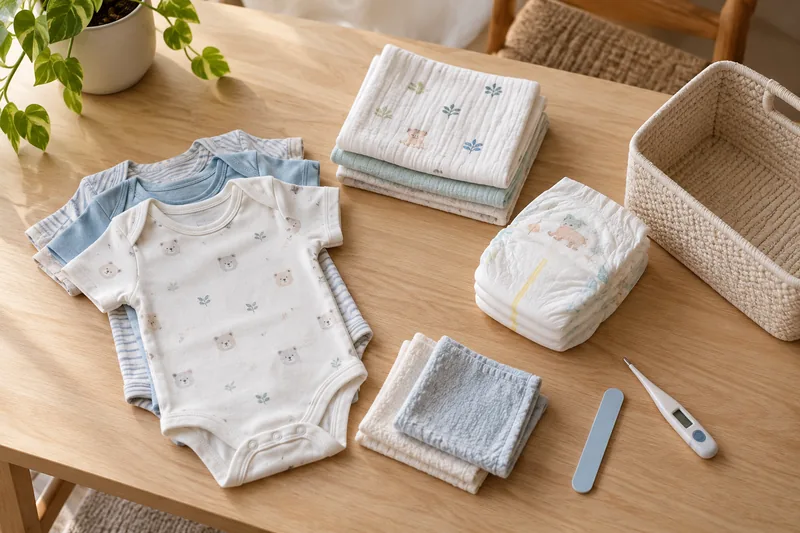
Start with an ordinary day at home
A useful newborn shopping checklist covers the jobs you will actually do: finding clean clothes, changing nappies, preparing a sleeping space, bathing and travelling home. Think about who will care for the baby, how frequently washing gets done and where supplies will live. A small home with daily laundry needs a different arrangement from one relying on clothes drying outdoors.
This is shopping and organisation guidance, not medical advice or a compulsory equipment list. Every quantity below is an editorial starting suggestion, not a measure of adequate care. Follow any specific instructions from your care team or the product manufacturer. The Bahasa Melayu version covers the same decisions so family members can work from matching information.
Choose a status before adding anything to a basket
First unpack gifts and check what you already own. Confirm sizes, condition and missing parts before counting something as ready. A borrowed item still at a relative's home needs an agreed collection date and someone responsible for bringing it over.
- Already owned: complete, suitable and somewhere you can actually reach.
- Buy: there is a clear job for it, room to store it and a reason to have it before the baby comes home.
- Borrow: the owner agrees, condition and instructions can be checked, and you have agreed when to return it.
- Defer: you do not yet know whether you will use it, can obtain it later or already have something that does the same job.
Suggested starting quantities
Treat this table as a way to organise a cupboard, rather than a bundle to purchase. If your target is six outfits and relatives have given you four suitable ones, you are looking for two more, not another six. Adjust after seeing how quickly laundry can be washed and dried.
| Item | Editorial starting point | Check before adding more |
|---|---|---|
| Everyday outfits | 6 sets | Buy only a little in the first size; prioritise easy changing and washing. |
| Small cloths | 6 | Keep clean and used cloths separate. |
| Bath towels | 2 | Consider drying space and laundry frequency. |
| Sheets matching the sleep product | 2 | Follow its measurements and instructions. |
| Nappies | 1 small pack initially | Confirm your chosen type and size before stocking up. |
| Changing mat | 1 | Check cleaning and storage. |
| Used-clothing bags or containers | 2 | One can be used while the other is cleaned. |
| Outing bag | 1 existing bag if suitable | Try small pouches inside it before buying another bag. |
Sleeping space, bathing and feeding equipment
Measure the place where a large item will be used before choosing it. Include doorways, walking space and storage when it is folded. For sleeping arrangements, read the product manual and ask your care team for safe-sleep guidance. Extra decorative accessories should not become automatic additions simply because they are sold in a matching set.
For bathing, organise the towel, clothes and place for supplies before filling a basket with products. Storage you already own may be enough. Feeding arrangements differ between families; discuss specific equipment with your care team before buying multiple pumps, bottles or accessories. This guide does not prescribe a feeding method, product or milk quantity.
Sunway Medical Centre publishes separate mother and baby admission lists. That is a useful packing example, but your hospital's instructions should determine your hospital bag. Keep the home-supplies list separate rather than carrying everything into the ward.
Transport and borrowed equipment
If you will travel by car, check a child restraint before the journey. JPJ's official FAQ refers to UN R44 or R129 standards and the E-Mark. Its linked model list is dated 2020; do not treat that list as a current shopping catalogue. Confirm the model, vehicle compatibility and installation using current information and the manuals.
Ask for a demonstration before deciding. With a stroller, try folding and lifting it, then measure your boot or storage space. Borrowed equipment also needs its instructions, complete parts and usage history checked. Appearance alone does not answer those questions. If important information is missing, do not mark it as ready for use just because someone has offered it.
Spend on the gaps, not the biggest bundle
Once existing supplies are counted, make a shopping list of the remaining gaps. Record actual seller prices yourself, including delivery, and compare the same quantities. Leave room in your budget for needs that become clearer later.
Gifts are easier to coordinate when relatives know which items remain unallocated. Give someone a specific task, such as finding two outfits in the agreed size, rather than a broad request for baby things. Keep receipts and care instructions together so size exchanges and warranty enquiries are straightforward.
Defer bulk clothes, bulk nappies and duplicate accessories until you understand their use. A special outing bag can also wait if your existing bag holds the essentials comfortably. The purpose of deferring is to keep a decision open, not to rule a product out forever.
Edit, check together and print
Open the shopping preset, change quantities and choose already owned, buy, borrow or defer. Add short notes about storage or who will collect an item. Your list stays in this browser on this device, without an account or form submission. Use the print dialog to make a paper copy or save a PDF to share.
Before placing an order, ask another caregiver to find three key supplies at home. If they cannot, improve the arrangement first. Review the list when gifts arrive. A short list that reflects the cupboard is more useful than a long one where every item has been marked essential.
Make the plan yours.
Edit quantities, choose buy or borrow, plan a flexible routine and print. Your entries stay on this device.
Open checklists & routineSources & checking
Dates record the page check, not a guarantee of current conditions. A limited-access note means the complete details could not be verified.
- JPJ: Sistem Kekangan Kanak-Kanak (CRS)
Official FAQ references UN R44/R129 and E-Mark. Its linked model list is dated 2020; it is not treated as a current shopping catalogue.
- Sunway Medical Centre: maternity admission checklist
Hospital-specific mother and baby packing list; not a universal Malaysian admission requirement.
Planning suggestions are editorial starting points to adapt; no outcome or suitability is guaranteed.